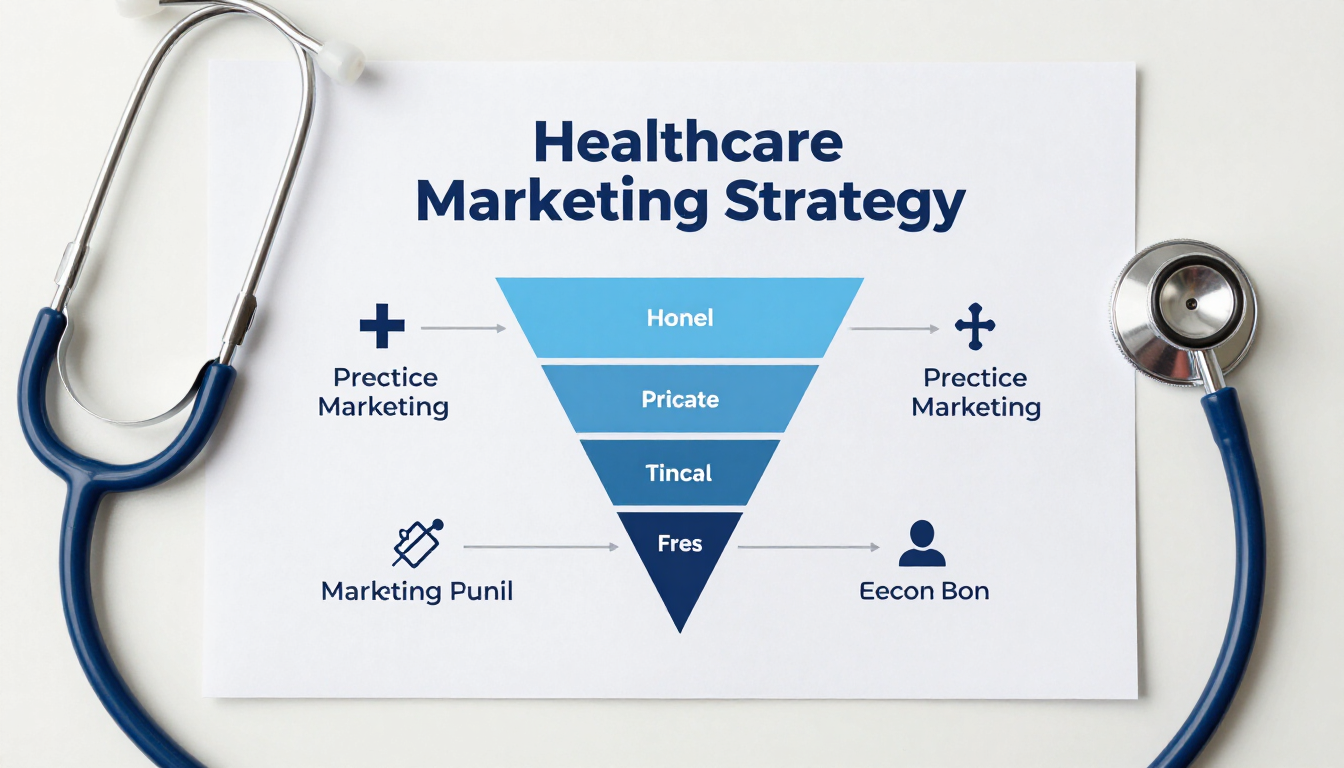
Medical practice marketing is the process of attracting, converting, and retaining patients through channels such as local SEO, Google Ads, an effective website, online reviews, and patient-focused content. This guide brings every piece together into one practical system — so you can see how the parts fit, where to start, and how to judge whether your marketing is actually producing appointments.
Most practices do not have a marketing problem so much as a coordination problem. They run an ad here, publish a page there, ask for reviews occasionally — and then struggle to tell which effort produced which patient. A complete marketing approach treats every channel as part of one system with a single measure of success: booked appointments. When you organise it that way, each piece reinforces the next, and your budget works harder.
What medical practice marketing includes
A complete medical practice marketing system spans six connected areas. None of them works in isolation — each one feeds the others, and a weakness in one place quietly limits the results of the rest.
- Local and organic search (SEO) so your practice appears when patients look for care.
- Google Ads to capture active demand quickly and test what converts.
- A high-performance website that turns traffic into appointment requests.
- Online reviews and reputation that persuade the next patient to choose you.
- Patient-focused content that answers health questions and builds trust.
- Tracking and analytics that connect every appointment to its source.
The unifying metric
Every channel above should be judged on the same number — appointments and enquiries it produces, not clicks, impressions, or vanity traffic. If a channel cannot be tied to bookings, you cannot manage it rationally.
SEO versus Google Ads
SEO and Google Ads are the two search channels most practices rely on, and they do different jobs. Google Ads places your practice at the top of results immediately in exchange for payment per click. SEO improves your site so it ranks organically over time, without per-click costs. The choice is not either-or — it is about which job you need done now.
Use Google Ads when you need patients this month, want to promote a new service, or need to test which keywords and treatments convert. Use SEO when you want a durable, compounding source of patients that gets cheaper per acquisition over time. Most growing practices run both — ads for speed, SEO for margin — and shift budget between them as organic results mature.
For a deeper comparison, read our guide to medical SEO versus Google Ads, or explore the dedicated Healthcare SEO and Google Ads for Patient Acquisition service pages.
Why the website affects appointment volume
Your website is where every channel eventually lands. Ads click through to it, organic results point to it, your Google Business Profile links to it. If the site is slow, confusing, or buries the booking action, you lose the patients every other channel worked to send there — and you usually never find out, because visitors who leave do not complain.
A practice site engineered for appointments does three things: it loads fast on mobile, it makes booking obvious above the fold, and it answers the patient’s real question — "can this practice help me, and should I trust them?" — with clear copy and proof. Improving conversion on the site often lifts appointments without spending any more on traffic. See our Medical Web Design service for how we approach this.
Local search and Google Business Profile optimization
For most practices, local search is where the highest-intent patients are. When someone nearby searches "best [your specialty] near me" or "[treatment] in [city]", you have one chance to be the practice they call. Your Google Business Profile is the single highest-impact local asset you own.
- Choose the most specific primary category that fits your practice.
- Complete every section — services, hours, attributes, service area, and a keyword-aware description.
- Add fresh photos regularly; active profiles earn more calls and direction requests.
- Build a repeatable review-request process and reply to every review promptly.
- Keep your name, address, and phone number identical across every directory.
Our step-by-step Google Business Profile guide walks through each of these in detail, and our Local SEO for doctors article covers how to rank in your city.
Tracking calls, forms, and booked appointments
If you cannot trace an appointment back to the keyword, ad, or page that caused it, every marketing decision becomes a guess. Most default analytics setups undercount conversions significantly, which means practices routinely spend on channels that look productive but are not actually booking patients.
Proper tracking means consent-aware tagging, GA4 configured around the actions that matter (calls, forms, bookings — not page views), and a measurement plan that maps every enquiry to its source. With that in place, you can calculate a real cost per acquisition for each channel and shift budget toward what earns its place. Our Healthcare Analytics service builds exactly this foundation.
How to create a practical marketing budget
A practical marketing budget starts from the outcome, not the spend. Decide how many new patients you need and what a patient is worth to your practice, then work backward to the channels and budget that can plausibly deliver them at an acceptable cost per acquisition. Costs vary widely by specialty, location, competition, and the services you promote, so avoid copying another practice’s numbers — model your own.
- 1Set a patient-growth target and a target cost per acquisition you can live with.
- 2Allocate budget across channels based on speed and margin needs — ads for now, SEO for later.
- 3Reserve a portion for the website and tracking, because they multiply every other channel.
- 4Review monthly against actual appointments, and reallocate toward what is working.
For a fuller breakdown of cost categories and what drives them, see our guide to medical practice marketing cost.
When to hire a healthcare marketing agency
Many practices can run the foundations themselves — a complete Google Business Profile, consistent business information, a review process, and clear treatment pages. The challenge is consistency and competition. If you are in a competitive market, your time is better spent with patients than in Google Ads, or your results have plateaued, professional execution usually pays for itself in patients you would otherwise lose.
Signs it is time to bring in help: you cannot tell which channel produces patients, your cost per acquisition is rising, your ad account wastes budget on irrelevant clicks, or you simply do not have the hours to manage marketing consistently. When you do hire, choose a partner that reports against appointments, lets you own your accounts and data, and understands healthcare compliance. Our guide to choosing a medical marketing agency lists the questions worth asking first.
The bottom line
Medical practice marketing is not a collection of tactics — it is one system measured in appointments. Get the foundations right, track honestly, and reallocate budget toward what books patients. Do that consistently and marketing becomes a predictable growth engine rather than a recurring expense.
Not sure where your practice stands? We will audit your marketing across search, ads, website, and tracking — and send you a plain-English map of the fixes that matter most, free.
Request a free practice marketing audit